-
1,041 Israeli Incursions into Syria Since Assad’s Fall, with Quneitra and Daraa Bearing the Brunt
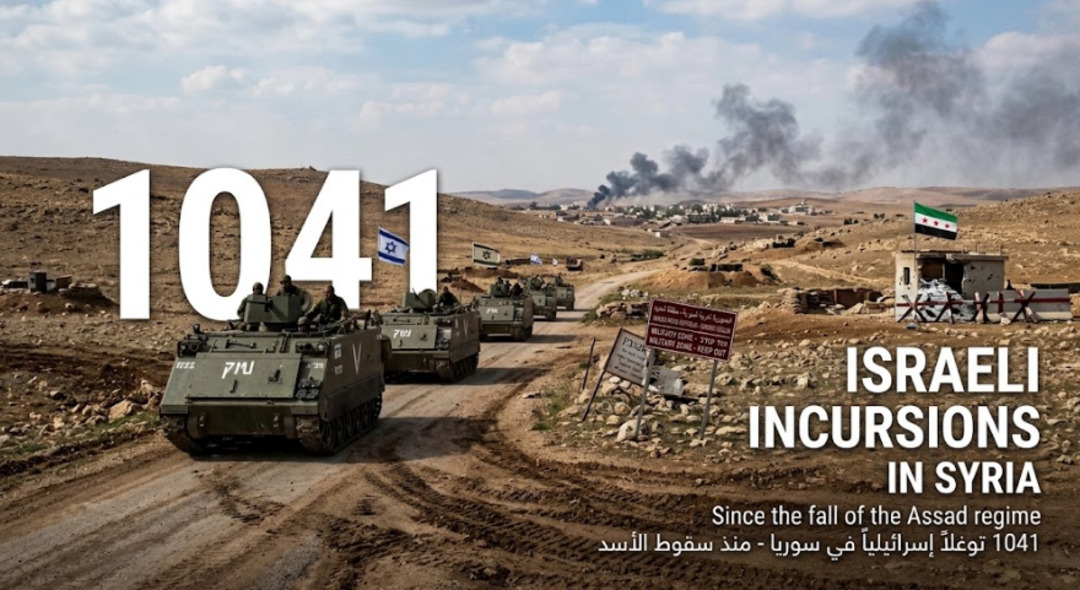
The "Syrian Observatory for Human Rights" has documented "1,041 Israeli incursions into Syrian territory since the fall of Bashar al-Assad’s government on December 8, 2024. Most of the incursions took place in the provinces of Quneitra and Daraa, alongside the establishment of military positions and repeated strikes.
Despite contacts and negotiations held in recent months between Damascus and Tel Aviv, Israeli military activity in southern Syria has continued, with Israeli forces maintaining a presence in several areas near the border.
According to the Observatory, 14 incursions were recorded during the remaining days of December 2024, while the number rose to 460 incursions throughout 2025. From the beginning of 2026 through early September, the Observatory documented an additional 567 incursions.
The Israeli movements recorded this year were distributed as follows: 51 incursions in January, 51 in February, 68 in March, 62 in April, 78 in May, 73 in June, 64 in July, and 95 in August—the highest monthly figure during this period. Approximately 25 incursions were also recorded during the first days of September.
Meanwhile, the Observatory documented around 68 Israeli strikes inside Syrian territory since the beginning of 2026, including six airstrikes and 62 ground attacks. The operations targeted approximately 13 sites, including remnants of weapons and ammunition depots, as well as military headquarters, facilities, and vehicles.
These developments coincided with Syrian-Israeli contacts and negotiations concerning Israel’s military presence and the escalating situation on the ground. Among these efforts were talks involving Syrian Foreign Minister Asaad al-Shaibani, particularly following the targeting of Abu al-Duhur Military Airport.
However, the talks did not halt Israeli incursions in southern Syria, amid repeated Israeli statements rejecting the deployment of Syrian forces near its borders. Israeli Prime Minister Benjamin Netanyahu said Israel would not allow what he described as a “terrorist army” to be stationed along its border, adding that control over the area stretching from Mount Hermon to the Yarmouk River represented one of the most prominent “achievements of the recent war.”
Netanyahu added that the location from which he spoke provided a view of large parts of Syria, Lebanon, and the Golan Heights, stressing the military and strategic importance of the area extending from Mount Hermon toward the Yarmouk River.
Israeli media outlets also focused on the military dimension of Israel’s presence on Mount Hermon. **Israel Hayom** described the site as the “crown of Syrian Mount Hermon,” while **Yedioth Ahronoth** highlighted Netanyahu’s remarks regarding control over the area between Mount Hermon and the Yarmouk River.