-
Iran Was Not Defeated. It Was Discarded.
-
A Theory Linking Hormuz, Venezuela, Syria, and the IMEC Corridor
Nayif Sha'ban
Istiqlal Forum for Political and Strategic Studies
in collaboration with the Levant Centre for Studies and Research — London
Somewhere in the Arabian Sea, an oil tanker carrying three million barrels sits at anchor. Its captain faces a choice that would have seemed absurd eighteen months ago: force passage through the burning Strait of Hormuz, or turn back and add fourteen thousand kilometers around Africa — three extra weeks, triple the cost. In a Shanghai refinery control room, a director stares at his screen and waits. In Bangladesh, universities closed this week because electricity has become a luxury. And in a Riyadh meeting room, a Saudi official traces a line on a map with his finger — from the Gulf, through Jordan, through Israel, to Europe.
These four moments are not separate events. They are the same moment, lived in different places. And understanding what connects them requires a single thread.
The thread is this: whoever controls the road controls the world.
Whoever controls the road controls the world.
But before tracing that thread forward, it is worth asking how we arrived here — because the path was neither accidental nor sudden. It unfolded in stages, each stage enabling the next, in a pattern that classical Arab political thought predicted with uncomfortable precision eight centuries before the events themselves.
In 1979, Iran's Islamic Revolution declared war on American hegemony. The rhetoric was unambiguous: resistance to Zionism, liberation of the Islamic world, rejection of Western dominance. The language was of defiance; the posture, of a civilization in confrontation with empire. What followed over four decades, however, was a paradox so stark it demands explanation. The project that proclaimed resistance to American-Israeli designs on the Middle East proceeded, methodically, to deliver exactly what those designs required: the fragmentation of Arab national states in Iraq, Syria, Lebanon, and Yemen; the deepening of sectarian divides until they became the primary language of regional politics; the exhaustion of Arab societies in peripheral conflicts that drained their capacity for political resistance; and — perhaps most consequential — the diversion of Arab attention from the Palestinian cause toward a manufactured Sunni-Shia confrontation.
Did Iran intend this? No. Did Iran coordinate with Washington? There is no evidence. Yet the objective outcomes served one party's interests with systematic consistency across two decades and multiple administrations. The Egyptian-American scholar Abdel Wahab El-Messiri, one of the most rigorous analysts of modern ideology, developed a concept for precisely this phenomenon: objective functionality. A phenomenon exhibits objective functionality when it consistently serves a party's interests regardless of the intentions of those producing it. You do not need a conspiracy to produce a conspiracy's results. You need a structure — what this analysis calls a prestructured interactive environment — in which independent decisions by autonomous actors reliably converge toward outcomes that benefit the hegemon.
You do not need a conspiracy to produce a conspiracy's results. You need a structure.
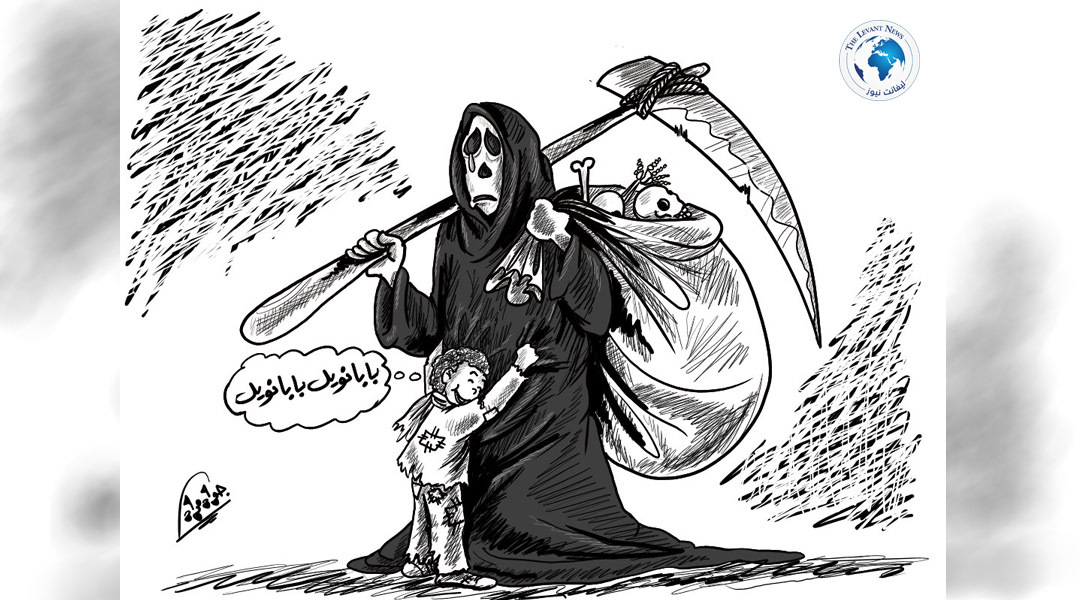
This is the theoretical core of Geopolitical Instrumentalization Theory, developed through a series of research papers published by this author since August 2025. The theory proposes three phases in the life cycle of an instrument. In the first phase — positive instrumentalization — the instrument actively generates outcomes that serve the hegemonic project. In the second — negative instrumentalization — the instrument exhausts its primary function and begins to generate costs. In the third — disposal — the instrument is discarded when the cost-benefit calculus tips decisively against its continued operation. The Iranian case proceeded through all three phases with near-textbook precision. Iran was instrumentalized in the fragmentation of Arab state structures. It was tolerated through the negative phase as long as its regional reach exceeded its nuclear ambition. And on February 28, 2026, the disposal phase began: American and Israeli strikes on Iranian nuclear facilities, missile infrastructure, and — in the opening hours — thirty senior military and nuclear commanders. The Supreme Leader himself was killed in the first wave.
The critical insight is not that Iran was weakened. It is why, and why now. Geopolitical disposal does not follow the logic of punishment. It follows the logic of project completion. Iran was not removed because it failed to serve American-Israeli regional interests. It was removed because it had succeeded — and its continued existence had become the primary obstacle to the next phase of the project.
Iran was not discarded because it failed. It was discarded because it had succeeded — and its continued existence had become an obstacle to what came next.
Ibn Khaldun, writing in fourteenth-century Tunis, described this dynamic as the logic of 'monopolization of rule' — the phase in which the victorious power eliminates the partners who helped it reach dominance. Not because they betrayed it. Because their usefulness has expired. The mechanism requires no malice; it requires only rationality applied to changing conditions. That a North African jurist and historian identified this pattern six hundred years before IMEC was conceived is not coincidence. It reflects the degree to which structures of power reproduce themselves across civilizational contexts, and the degree to which classical Arab political thought offers analytical tools that Western international relations theory has yet to formalize.
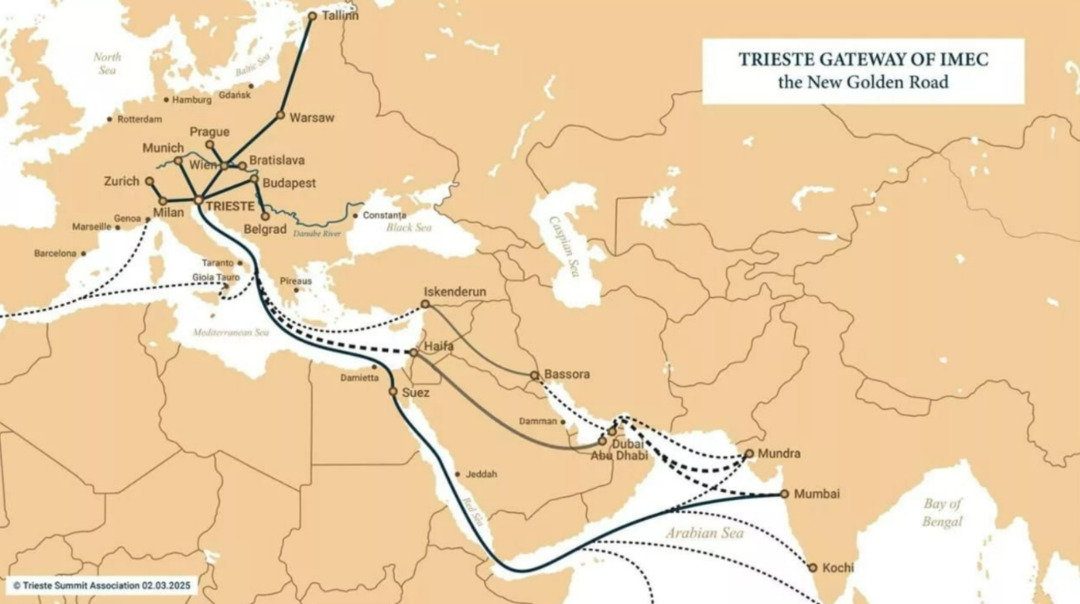
What comes after a discarded instrument? The answer to that question is IMEC — the India-Middle East-Europe Economic Corridor, signed in New Delhi in September 2023 by the United States, India, Saudi Arabia, the UAE, Israel, and the European Union. The document attracted little attention. It should have attracted enormous attention. IMEC is a land-and-sea trade corridor connecting India to Europe through the Gulf, Israel, and the Mediterranean — rail lines, ports, digital cables, energy pipelines. President Trump has called it 'the greatest trade route in the history of the world.' His designers were more precise: it is the American answer to China's Belt and Road Initiative. A road against a road. A system against a system.
IMEC required two things it did not have in September 2023: the removal of Iran's chokehold on Hormuz, and Arab-Israeli normalization sufficient to make a land route through Israel operational. In the twenty-nine months since the signing, observe what has occurred. In January 2026, Maduro's government fell in Venezuela and Washington announced American management of Venezuelan oil — oil that had been supplying China at discount prices outside the American sanctions regime. In February 2026, the war on Iran began, closing Hormuz. In January 2026, Syrian and Israeli representatives met in Paris under American mediation and agreed to accelerate security normalization talks. Three events. Three months. The two obstacles to IMEC — Iranian control of Hormuz and the absence of Arab-Israeli normalization — addressed in sequence.
The two obstacles to IMEC — Iranian control of Hormuz and the absence of Arab-Israeli normalization — addressed in sequence, in three months.
Venezuela is the piece that looks distant until placed in its correct position. China sourced approximately 600,000 barrels per day from Venezuela — discounted oil outside American sanctions architecture — and comparable volumes from Iran through similar arrangements. This triangle — Venezuela, Iran, Russia — represented roughly one-fifth of China's total oil imports, all of it beyond the reach of dollar surveillance. China holds strategic petroleum reserves sufficient for ninety-six days of imports. With Venezuela now under American management and Iran's export infrastructure degraded, those ninety-six days acquire a different quality: not a buffer, but a countdown. The energy siege of China — tightening simultaneously from the Gulf and from Latin America — is not a side effect of Middle Eastern policy. It is the architecture. What analysts call 'friend-shoring' and 'supply chain restructuring' is, viewed structurally, a process of ensuring that the raw materials required for Chinese industrial and technological capacity flow through corridors that Washington controls or can interrupt.
Syria sits at the center of this map in a way that is rarely stated plainly. The land route that IMEC requires to reach Europe from the Gulf passes through Syrian territory. Without Syria, the corridor is incomplete. Syria, having emerged from a devastating war that eliminated eighty-five percent of its pre-2011 GDP, requires approximately one hundred billion dollars in reconstruction financing. That financing cannot arrive without the lifting of American sanctions. The lifting of American sanctions is conditioned — as the context makes unmistakably clear — on a security pathway toward normalization with Israel. The Syrian revolution was genuine. The terms being attached to its reconstruction were established before the revolution concluded.
This is not a counsel of despair. It is an invitation to precision. Malik ibn Nabi, the Algerian philosopher who developed the most rigorous account of the Muslim world's structural vulnerabilities in the mid-twentieth century, coined a concept he called 'colonizability' — the internal disposition that makes a society available for external manipulation before the manipulator arrives. The question he would ask of Syria today is not whether external pressures are real. They are. The question is whether Syrian leadership understands the structure of the pressure it faces with sufficient clarity to navigate it rather than submit to it. Turkey's sustained presence in Syrian affairs, China's interest in Mediterranean access, Russia's determination to preserve its naval foothold in Tartus — these competing external interests, which look like threats, are also the only source of negotiating leverage Damascus possesses. The power of the weaker party in a geopolitical negotiation is not military. It is the capacity to make itself indispensable to more than one of the stronger parties simultaneously.
There is a question, finally, that this analysis cannot answer — but that those reading it must answer for themselves.
The tanker anchored in the Arabian Sea. The Chinese refinery director watching his screen. The university closed in Bangladesh because electricity costs too much. The finger tracing IMEC's route on a map in Riyadh. These are not random coincidences that happened to cluster in early 2026. They are coordinates in a single equation, written in the language of oil and corridors and sanctions and precisely calibrated wars.
The only question that matters is whether the people inside this equation know they are inside it — or whether they still believe they are watching separate events covered by separate newscasts every evening.
Nayif Sha'ban is the founder and research director of the Applied Arab Heritage Models Project at IFSS Damascus, and a researcher at the Istiqlal Forum for Political and Strategic Studies in collaboration with the Levant Centre for Studies and Research, London. He is the author of the ongoing research series on Geopolitical Instrumentalization Theory (GIT). He publishes at naifshaaban.substack.com and independent.academia.edu/NaifShaaban.
Selected References
Ibn Khaldun, Abd al-Rahman (d. 1406). Al-Muqaddima [The Prolegomena]. Ed. Darwish al-Juwaidi. Damascus: Al-Maktaba al-'Asriya. [Analysis of the phases of state power and the logic of monopolization of rule.]
Malik ibn Nabi (1905–1973). The Conditions of Renaissance [Shurut al-Nahda]. Trans. Omar Masqawi. Damascus: Dar al-Fikr, 2000. [The concept of colonizability as internal structural disposition.]
El-Messiri, Abdel Wahab (1938–2008). Encyclopedia of Jews, Judaism, and Zionism: A New Explanatory Model. Cairo: Dar al-Shuruq, 1999. [The concept of objective functionality.]
Sha'ban, Nayif. 'The Abrahamic Policy: How the Umm al-Qura Project Became a Geopolitical Instrument.' Istiqlal Forum, August 2025.
Sha'ban, Nayif. Geopolitical Instrumentalization Theory — Theoretical Introduction, Revised Edition. Istiqlal Forum, March 2026.
ACLED. Iran Conflict Observatory: Strike Data, March 2026. Updated March 18, 2026.
Kpler. China Oil Import Vulnerability: Sanctioned Supplier Data. February 2026.
Chatham House. 'Trump's Syria Policy is at Risk of Unravelling.' January 2026.
Crisis Group. 'IMEC: The Infrastructure Behind the Abraham Accords.' October 2023.
House of Commons Library. 'Iran: Impacts of June 2025 Israel and US Strikes.' CBP-10292, February 2026.
Al-Jazeera English. 'US, Israel Bomb Iran: A Timeline of Talks and Threats.' February 28, 2026.