-
Amarna Miller’s Visit to Syria Sparks Debate, from the Umayyad Mosque to Palmyra
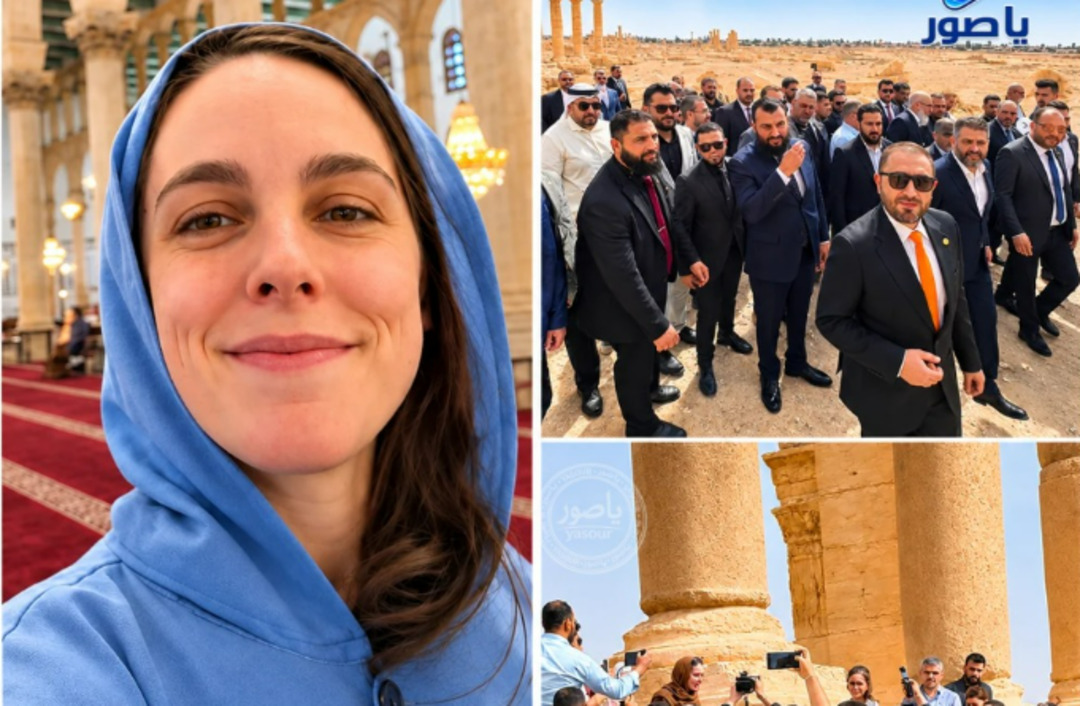
The visit to Syria by Amarna Miller, a Spanish content creator and former adult-film actress, sparked widespread debate on social media after videos showed her at Damascus’s Umayyad Mosque and the ancient city of Palmyra. Much of the discussion focused on her past career and the presence of government officials during her tour. The debate extended beyond the visit itself to questions of personal freedom and moral standards in Syria following the fall of Bashar al-Assad’s government.
The videos showed Miller visiting several historic and tourist sites. Syrian Culture Minister Mohammed Yassin Saleh also appeared with a group accompanying her in Palmyra, prompting questions about the nature of the visit, who had organized it, and whether it was part of an official effort to promote tourism. Details of any coordination between Miller and government bodies were unclear, and there was no official clarification on whether the Ministry of Culture had invited her.
Comments on social media were divided. Some focused on the presence of government officials alongside Miller, while others criticized her for her former work in the adult-film industry, arguing that her background was incompatible with visiting religious sites, including the Umayyad Mosque. Others defended her right to visit Syria and its historic and religious landmarks, regardless of judgments about her personal life or professional past.
Miller shared material from her visit on Instagram, discussing Syria’s cultural history and the destruction caused by years of war. She also highlighted the contributions of civilizations that flourished in Syria to the development of writing and music, including the ancient musical heritage of Ugarit. One of the oldest known musical notations was discovered there, along with the Ugaritic alphabet, considered one of the earliest alphabetic writing systems. The post was later removed from her account as the debate intensified. It was unclear why it had been taken down or whether the decision was related to comments on the circulating videos.
Miller is a Spanish content creator and writer who previously worked in the adult-film industry. She left the industry in 2017 and later focused on writing and producing content about travel, culture, and the arts. She studied fine arts and anthropology and has also taken part in tourism projects centered on cultural experiences and learning about local communities.
Her activities have also included participating in seminars and awareness events addressing women’s rights, the rights of sex workers, equality, and anti-discrimination. During her career, she received professional awards, including the Ninfa Award for Best Spanish Actress in Adult Films in 2014 and the TEA Award for Best Performer in 2017. In a 2019 interview with the Spanish newspaper *El País*, she spoke about the social stigma she faced after leaving the industry, saying that her former work in adult films would remain a stigma attached to her for the rest of her life.
Despite the range of her activities, some of the commentary focused on her former profession, overlooking her current work in travel and content creation. This renewed questions about reducing people to one stage of their professional lives and using it as the basis for judging their presence in public spaces.
The controversy also reopened discussion about the distinction between individuals’ right to travel and visit public places, and the accountability of official institutions for their activities. The appearance of government officials during a public figure’s visit raises legitimate questions about the nature of their involvement and how the visit was organized. However, it does not in itself prove that the visitor received special treatment or an official invitation from the government.
At the same time, the criticism directed at Miller because of her former profession raised questions about social stigma and moral judgments, which disproportionately affect women. A tourist visit became an occasion to assess the visitor’s personal history and whether she was “worthy” of entering the country or visiting its landmarks. This prompts questions about using moral positions as a basis for judging individual rights, rather than relying on the laws governing visitors’ entry into the country and access to public places.
The reactions reflect the continued influence of conservative social norms in debates about personal freedoms—norms that extend beyond the nature of political authority to encompass broader social and cultural attitudes. While the public has the right to question officials about how visitors are received and accompanied, shaming Miller or disputing her right to visit the country because of her professional past raises questions about the limits of tolerance for difference, and whether calls for freedom and women’s rights are consistent with respecting individual choices that may not be widely accepted.
The debate carries added significance in Syria, where discussions have continued since the fall of Assad’s government in December 2024 over the shape of the new state and the place of personal freedoms and women’s rights within it. From this perspective, the treatment of visitors—regardless of their profession or background—is connected to broader questions of pluralism, respect for difference, and the limits of interference in individual choices.
The controversy also highlights a tension between calls to advance rights and freedoms on the one hand, and the public shaming or degrading of individuals because of their professional past on the other. Discussions of women’s rights and civil liberties are not limited to defending groups that enjoy broad social acceptance; they also involve respecting the rights of people whose experiences or choices may be objectionable to some segments of society.