-
"Palestinian Publishers" publishes the book "Extensive Additions to Beloved Chatter"
Press report | Ramallah – Occupied Palestine (translated by DeepL)
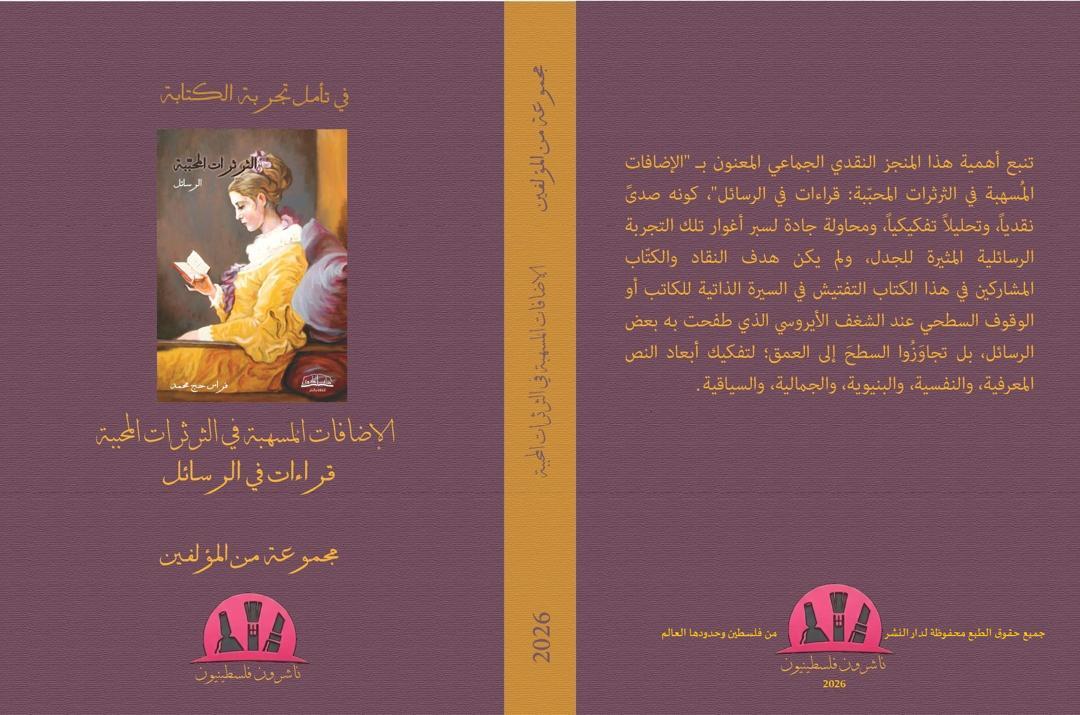
The “Palestinian Publishers” publishing house has launched, on free e-book platforms, its first edition for 2026 of the expanded critical work entitled “Extensive Additions to Beloved Chatter – Readings in Letters”, which bears the publisher’s motto: “From Palestine and its borders to the world”.
This pivotal intellectual work is distinguished by the fact that the critical, analytical and epistolary material it contains has been entirely compiled, edited and prepared by the academic team at “Palestinian Publishers”, to serve as a comprehensive reference covering all the stylistic, psychological and political dimensions raised by the book Beloved Chatter: The Letters by the Palestinian poet and critic Feras Haj Mohammad. The new book comprises approximately 200 pages of medium size, and its cover was designed by the Palestinian artist Maysam Feras.
The foreword, written by ‘Palestinian Publishers’, emphasises that the genre of ‘epistolary literature’ is one of the most elusive and risky literary genres; as it straddles the fine line between emotional exposure and expressive risk-taking in the face of a critical public reception. In the contemporary Palestinian and Arab literary scene, the book Beloved Chatter: Letters by the author Feras Haj Mohammad has emerged as a cornerstone of this debate; for it dares to engage directly with the ‘forbidden quadrangle’ comprising religion, sex, politics and social issues, alongside critical practice of a moral nature.
From this perspective, the significance of the critical volume Extensive Additions to Beloved Chatter stems from its role as a serious attempt to probe the depths of this epistolary experience, laden with sincerity and human vulnerability. The aim of the essays in this book was not to scrutinise the autobiographical elements or dwell on the superficial emotions flowing through the letters, but rather to deconstruct the cognitive, psychological, feminine, aesthetic and political dimensions present within the folds of the correspondence.
This critical work comprises three main sections combining critical and academic analyses, journalistic documentation and algorithmic analysis using artificial intelligence, alongside a special section that recovers omitted letters not included in the first edition of the book Beloved Chatter.
The researcher and critic Muhammad al-Shabrawi opened the critical readings with an extensive study entitled ‘The Writer Between the Hammer of the Halo Effect and the Anvil of Criticism’, taking Feras Haj Mohammad’s letter dated 8 August 2018 as his analytical starting point.
Through the letter and its contents, Al-Shabrawi addresses a deep-rooted crisis in the Arab literary reception landscape, where young and unknown creators suffer from marginalisation and the shock of encountering a barrier blocking their creative endeavours. Al-Shabrawi identifies an acute psychological and critical phenomenon known as the ‘halo effect’ (Halo Effect), whereby the public and critical institutions tend to be automatically dazzled by the works of illustrious and famous names, regardless of the text’s true artistic value, whilst the spotlight of acclaim is withheld from lesser-known creative talents.
In this context, Al-Shabrawi cited a pivotal historical event in Egyptian literary life in 1963, when Ahmed Rajab, editor of Al-Kawakib magazine, staged a famous critical prank, in which he asked the critics Abdel Fattah Al-Baroudi, Rajaa Al-Naqqash, Sa’ad Ardash, and Abd al-Qadir al-Qat to provide an artistic assessment of an absurdist play he claimed had been written by a foreign author. The critics lavished praise on the author’s exceptional skill in plot construction, linguistic economy and the expression of existential tragedy. The cultural scandal escalated when Ahmed Rajab revealed himself, explaining that he had written the text in an hour without any purpose, meaning or genuine drama.
Al-Shabrawi did not stop there, but presented another satirical experiment in contrast to this one. He selected an article by one of the great luminaries and claimed that its author was a young writer whom Al-Aqqad had described as having “lines halfway there that deserve encouragement”, Ihsan Abdel Quddous described it as “a style unfit for publication”, whilst Anis Mansour said “the style isn’t bad”, and Amina al-Sa’id gave it “zero out of ten”.
Al-Shabrawi uses these anecdotes to corroborate Feras Haj Mohammad’s argument regarding the dominance of well-known names, offering advice to young writers on the need to persevere and be patient, and not to wait for praise or succumb to the indifference of the cultural milieu.
In the second review, the writer Hassan Abadi offers a meticulous and comprehensive analysis of the book Al-Thartharat al-Mahbuba (Beloved Chatter), beginning by examining the world-famous painting The Reader by the artist Jean-Honoré Fragonard, noting that the choice of a woman reading with passion reflects a feminine aesthetic liberated from the constraints of academic rigidity. He then addresses the book’s dedication to every woman with whom the author has corresponded, noting that this emotional dialogue is ongoing and never-ending. Abadi emphasises that, despite the overtly frivolous nature that may be apparent on a first reading, a deeper analysis reveals highly significant philosophical, political, social and critical themes.
Abadi focuses on key themes raised by Hajj Muhammad in his letters:
Attitudes towards authority and politics: The author lays bare the reality of corruption in Palestinian and Arab affairs, offering his stark observation: ‘The homeland is for all, but the spoils are for the corrupt’, and emphasising the alliance between the instruments of internal tyranny and the occupying power to divide up the stricken homeland and subjugate its citizens.
Cliquenism in cultural circles: The author exposes the narrow self-interest that characterises the Palestinian and Arab Writers’ and Intellectuals’ Union, pointing to the failure of intellectuals to rise to the challenge of elections and public office, and citing the decline of the cultural scene and the prevalence of sycophancy.
The literary world and human connection: The author highlights his appreciation for creative and philosophical figures such as Gibran Khalil Gibran, May Ziadeh, Franz Kafka, Nietzsche, Malek Bennabi, Ghada Al-Saman and Fadwa Tuqan.
Sex and the Body: Abadi criticises the explicit and graphic sexual scenes in the letters addressed to ‘Amira al-Wajd S.H.’ and other correspondents, explaining that the author has gone to excess in his direct sensory descriptions of sexual intercourse and the details of the female body; nevertheless, Abadi believes that the body is employed here as a means of conveying the author’s philosophy of rebellion and spiritual purification.
After Human Suffering (Sophie’s Letters): Abadi focuses on the poignant correspondence and emotional exchange with the writer ‘Sophie’, who was stricken with a terminal illness and decided to return to her family and children, highlighting the agonising conflict between the body’s desire for life and the power of illness and death – a conflict that lends the letters a tragic, human depth that touches the heart.
The critic Ra’ed al-Hawari offers an insightful analysis entitled ‘Cultural Enrichment and Human Richness in the Book Beloved Chatter’, in which he begins by diagnosing the crisis in contemporary publishing, which is mired in repetition and trivial content, whilst the novel dominates at the expense of other literary genres. Al-Hawari argues that Feras Haj Mohammad’s foray into the ‘epistolary’ genre represents an exceptional literary venture that breaks with the mainstream and the familiar.
Al-Hawari addresses several themes within the book’s structure:
His stance on the novel: Hajj Muhammad answers the question ‘Why don’t you write a novel?’ by expressing his refusal to conform or pander to the demands of the cultural market (‘the dictatorship of the novel’), emphasising that writing is the absolute master that guides the writer, and that the freedom of letters grants him independence without submitting to common consumerist models.
The body and the act of writing: Hajj Muhammad links the act of writing to the sexual act; writing is a secretive act requiring solitude and rituals akin to those of sexual intercourse, which he sees symbolically taking place between pen and paper to generate the creative text.
The World of Imagination and the Creation of Don Juan: Al-Hawari analyses the intense presence of imagination in the letters, emphasising that the writer does not merely convey pure reality, but rather constructs a literary project that uses women’s bodies and emotions as raw material from which to distil literary fragrances. Here, women serve as the fuel for the construction of a startling and shocking text, in which the writer deliberately creates the ‘Don Juan’ of his era to overcome his past emotional disappointments.
The Philosophy of Sex and Women as Bells: Al-Hawari highlights the author’s vision of sex as an act of spiritual and physical union aimed at returning to the origin of oneness prior to the separation of selves; he also dwells on the innovative metaphor proposed by Hajj Muhammad, namely that ‘a woman is a collection of bells’ (the tongue and the mouth, the breasts, the clitoris, the woman’s body and her dress), treating the female body as a system of aesthetic and philosophical resonance.
The philosophy of opposites and complementarity: The author draws on verses from the Qur’an to formulate his vision of the emergence of the living from the dead, and the interplay of opposites (male and female, rebellion and purification, matter and spirit), emphasising that the idea transcends individuals.
Political parties: The author believes that organisational affiliation with a political party threatens creative freedom, drawing on his past experience with the Liberation Party and his decision to leave it in favour of a free intellectual sphere, whilst not abandoning the party’s ideas on politics, jurisprudence, belief and social life.
Literary awards: The author expresses his contempt for cultural awards, describing them as a writer’s graveyard that turns him into a pursuer of illusions.
Religious Institutions and Preachers: He criticises the narrow-minded view held by some preachers who reduce Paradise and the bliss of the Hereafter to mere gatherings for sexual pleasure, emphasising that Paradise is loftier and deeper than this distorted conception.
The Occupation and the Palestinian Authority: The author describes the daily hardships of life under the Zionist occupation at military checkpoints, whilst also exposing administrative and professional corruption in appointments and government interviews conducted by the Palestinian Authority.
The author’s nobility and the highlighting of others: Al-Hawari commends Feras Haj Mohammad for documenting the responses of readers and critics and including them at the end of his books, thereby upholding a democratic practice that allows opposing views to be expressed with dignity and integrity.
The publisher’s review (‘Palestinian Publishers’), entitled ‘The Semiotics of Anger and the Structure of the Oppressed Psyche’, offers an unprecedented critical analysis of the extremely harsh and bizarre conclusion with which Hajj Muhammad ends his collection of letters.
This chapter is an attempt to deconstruct the text using the tools of a composite psycholinguistic approach (combining semiotics and psychoanalysis). It focuses on the shocking letter in which the author unleashes his explicit curses upon a woman who remains unmoved by love poems, and the analysis provides a meticulous deconstruction of these animal and psychological symbols:
The fox in the mouth: the transformation of the seat of poetry and kisses (the mouth) into a fox’s den, symbolising cunning and linguistic desecration.
Mice on the playful breast and in the letters: the transformation of the breast – the seat of femininity, lactation and motherhood – into a playground for mice, which express fear, ruin and revulsion.
Spiders under the armpits: a sign of clinical death, existential neglect, stagnation and the accumulation of tissue decay.
Flies in the vulva: the transformation of the vulva – the centre of pleasure, childbirth and feminine seduction – into a habitat for flies, decay and symbolic filth.
Grasshoppers, ants and scorpions on the back, stomach and thighs: the complete stripping of the female body of its qualities of beauty and softness, and its transformation into a theatre for harmful creatures, stinging and pain.
This psychological analysis suggests that this intensely vitriolic discourse does not stem from a misogynistic stance in the traditional institutional sense; the author is considered one of the greatest advocates of feminist literature in his critical work Writing in Confrontation. Rather, the text reflects a narcissistic outburst and a state of overwhelming rage stemming from disappointment and human helplessness; for when his feverish, passionate letters were met with indifference or silence by the woman who did not respond to the poem’s seduction, the writer retreated into his wounded self and launched a defensive, cathartic attack, pouring his verbal curses upon that unyielding body. This act represents a release of repressed tension and a transformation of real-world aggression into symbolic revenge through the ‘curse of writing’.
The critic Dr Sarmad Fawzi Al-Tayeh offers a personal and profound critical account and analysis, stemming from his close friendship with the author Feras Haj Mohammad dating back to their university days in the 1990s. Al-Tayeh begins by noting that this book is a complete and unflinching self-revelation; as the author boldly lays bare himself and his emotional shortcomings before the reader and the cultural milieu.
Al-Tayeh observes the sharp fluctuations in Hajj Muhammad’s language; he shifts between the heights of spiritual transcendence and subtle, ethereal poetry drawn from the spirit of Sufism and the freshness of nature, and between obscene, unadulterated, explicit expressions and the interplay of words.
Al-Tayeh highlights the author’s treatment of themes such as debt, personal anxieties, the experience of education and upbringing, the unmasking of cultural figures and official institutions, his stance on political parties and politics, and reflections on death and illness; he also reviews the testimonies and reactions of dozens of writers and readers, whose comments are recorded in the final section of the book.
In the second reading, entitled ‘The Thorn-Tipped Lines Between Eroticism and Religion’, Dr Sarmad Al-Tayeh delves into the most complex intellectual and ethical dilemma in Beloved Chatter: the intense conflict and thorny lines between explicit eroticism and the deep religious inclination found in Feras Haj Mohammad’s work. Al-Tayeh analyses the stark paradox: How can a single writer blend depictions of obscene sexual intercourse, overt sensual ecstasy and a desire to devour bodies with direct quotations from the Qur’an, references to the Prophetic Hadith, and supplication and imploration to God in times of illness and infirmity?
Al-Tayeh traces the manifestations of this intellectual network through:
Recurring Qur’anic intertextuality: Hajj Muhammad invokes Qur’anic verses within his emotional and erotic contexts, such as ‘You will not be able to remain patient with me’, ‘Glory be to Him who took him away’, ‘My earth is vast’, ‘And His command was a decree’, and ‘Then a whirlwind struck him, containing fire, and it was burnt up’.
Rituals of purification and creative prayer: The author describes entering a ritual akin to spiritual stations before composing his letters, blending the scent of perfume and intimacy with his beloved with the recitation of the Holy Qur’an or supplication to purify the soul.
Historical Roots in Islamic Literature: Al-Tayeh attributes this blend to the early intellectual background of Hajj Muhammad, who was an active member of the Islamic Liberation Party.
Attitude towards death and illness: The religious dimension becomes clearly evident when the author is afflicted by severe bouts of illness; he strips himself of all frivolity to supplicate humbly to God, expressing his human fear of being cut off from worship and hope, and accepting the inevitability of death and the return to dust as his predestined fate.
The second section of the book is devoted to press coverage and the perspective of digital algorithms, with the critical work extending to document the reception of the book Beloved Chatter in the Arab press and contemporary technological applications.
The book includes a press report from Cairo by the writer Fathi Mahmoud, entitled ‘150 Beloved Chats… A New Release in Epistolary Literature’; the report highlights the historical value of epistolary literature in both the Arab heritage and contemporary literature (referring to the letters of Mahmoud Darwish, Samih al-Qasim, May Ziadeh, and Gibran Khalil Gibran), and considers Feras Haj Mohammad’s book to be a safe emotional haven and a breath of imagination in an age of virtual technological clamour.
This section also includes an algorithmic analysis of the letters as a conscious strategy to break the ‘dictatorship of a single, directed perspective’, and this algorithmic reading reveals that, in Feras Haj Mohammad’s letters, chatter is transformed from a fleeting daily act into a tool for delving into the layers of the human psyche, where language becomes a living, organic apparatus that breathes, sweats, bleeds, and brings about catharsis for both the reader and the writer alike.
The book Extensive Additions is unique in that it includes a special, separate section entitled ‘Letters Not Omitted by Mistake’, a collection of letters excluded from the first edition of Chit-Chat, which had previously been published as part of the book Personal Space – From the Diaries of the War on Palestine (2023). These letters serve to deepen the cultural, political and emotional understanding of Feras Haj Mohammad’s project.
The collection opens with the letter ‘Why Am I Writing to You About Algeria?’, in which the author addresses a lengthy letter to one of his friends, tackling the issues of identity and culture in neighbouring Algeria, and focusing on:
The question of language and identity: the author analyses the complex interplay between Arab, Amazigh and French identities in Algeria, expressing his understanding of the Francophone cultural scene that has produced great writers who resisted the occupier using the French language itself.
The historical memory of the struggle: The author evokes the symbolism of the one and a half million martyrs and the enduring emotional bond between the Palestinian and Algerian peoples.
Personal memories and literary career: The author looks back on his early days and his work published in various Algerian newspapers (‘Al-Jaza’ir al-Jadida’, ‘Sawt al-Asri’, ‘Al-Jadid al-Yawmi’, ‘Al-Sha’b’, ‘Al-Salam’), as well as his memories of the Algerian writer Leila Rabah, who wrote a short story about him entitled ‘The Poet, the Follower and the Libertine’, which she published in her collection of short stories.
There are other letters in which the author addresses the ‘Sword of Jerusalem’ campaign and its national dimension; this collection is considered among the most impactful, having been written amidst the sound of gunfire and rocket strikes during the military escalation and aggression against Gaza, Jerusalem and the Palestinian heartland in May 2021:
The letter “Eid in Palestine is… different” (3 May 2021): The author describes the flavour of Eid, mingled with blood and steadfastness, in Jerusalem, the Sheikh Jarrah neighbourhood, Gaza and the territories occupied in 1948, and emphasises that the joy of Eid in Palestine lies in the images of the smiles of the martyrs, prisoners and those holding their ground, who face the machinery of oppression with cheerful, radiant faces. The book includes replies to the correspondence from two female writers: (R. G.) and (I. S.).
Letter: ‘It Is a Different Day’ (2 May 2021 – the day the ceasefire was announced): The author expresses the euphoria of popular victory, emphasising that the war has restored comprehensive national unity amongst the Palestinian people wherever they may be. With scathing criticism, the author addresses the media outlets and intellectuals affiliated with the Arab and Palestinian authoritarian regimes.
The Philosophy of ‘Home’ and Shelter: The author delves into an analysis of the meaning of ‘home’—which the occupation is demolishing in Gaza—explaining that a home is more than just walls or physical property; it represents psychological shelter, tranquillity, a repository of memories and a comprehensive sense of self. He contrasts the warmth of the Palestinian home – even when reduced to rubble – with the cold, transient hotel rooms that offer no sense of spiritual belonging.
The article ‘With Songs and Hashtags, We Fight Them Too’ (26 May 2021): This piece addresses cultural and digital resistance, condemning the occupation’s destruction of the famous ‘Samir Mansour’ library in Gaza and the accompanying ban on Palestinian content on digital platforms and social media. It emphasises that peoples regain their creative vitality through national songs and solidarity in all its forms, even if only digitally.
The essay ‘Expected and Unexpected Disappointments’ (5 June 2021): On the anniversary of the June 1967 defeat, the writer recalls the hardships of military checkpoints and the news of the poet Tamim al-Barghouti’s suicide attempt. He looks back on his early days with the ‘Jerusalem Writers’ Association’ and the newspaper Al-Risala, expressing his deep disappointment with the cultural scene and literary associations, which he describes as being based on self-interest, cliquishness and cultural decay.
The essay ‘If Only You Were With Us’ (6 June 2021): The author recalls the most enjoyable moments of poetry recitals, when he read his poems for Gaza, illustrating how poetry grants its author a liberating energy and a sense of ecstasy that transcends wounds.
This book, Extensive Additions to Beloved Ramblings – Readings in Letters, published by “Palestinian Publishers”, invites researchers and critics to re-examine the literary text free from prevailing moral or stereotypical preconceptions, and affirms that literature and art constitute a critical and psychological record documenting a pivotal phase in the history of contemporary Palestinian literature. By compiling, editing and re-presenting this wealth of critical material, the publisher has succeeded in placing the reader and the researcher before a comprehensive analytical mirror that transcends superficial, impressionistic reading to delve into the deepest structural, psychological, and aesthetic contradictions that characterised the experience of the writer Feras Haj Mohammad in his composition of this genre of literature. It becomes clear that the letters are not mere ramblings devoid of purpose, aim or the vast cultural reservoir; rather, life pulsates through them in all its personal and social, religious and cultural diversity.