-
Douma Decision Banning Grooms from Women’s Wedding Parties Sparks Debate over Legal Authority

A decision issued by the Executive Office of the Douma City Council in the Damascus countryside, banning grooms from entering women’s wedding parties, has sparked widespread debate. Supporters view it as a measure to organize wedding celebrations and preserve their privacy, while critics question the decision’s legality and the limits of local councils’ authority.
According to the circulated decision, “male grooms” are prohibited from entering women’s wedding parties, with measures to be taken against violators. The Executive Office based its decision on Local Administration Law No. 107 of 2011.
The decision has reignited discussion over the powers granted by law to local councils and their executive offices, and whether those powers extend to regulating social customs and practices or are limited to administrative, service-related, and organizational matters within their jurisdiction.
It has also raised questions about whether a local executive body has the authority to impose restrictions on a social practice about which families and local communities may hold differing views. The presence or absence of the groom at women’s wedding parties is often linked to customs and traditions that vary from one area to another, and may be a personal choice for the groom and his family.
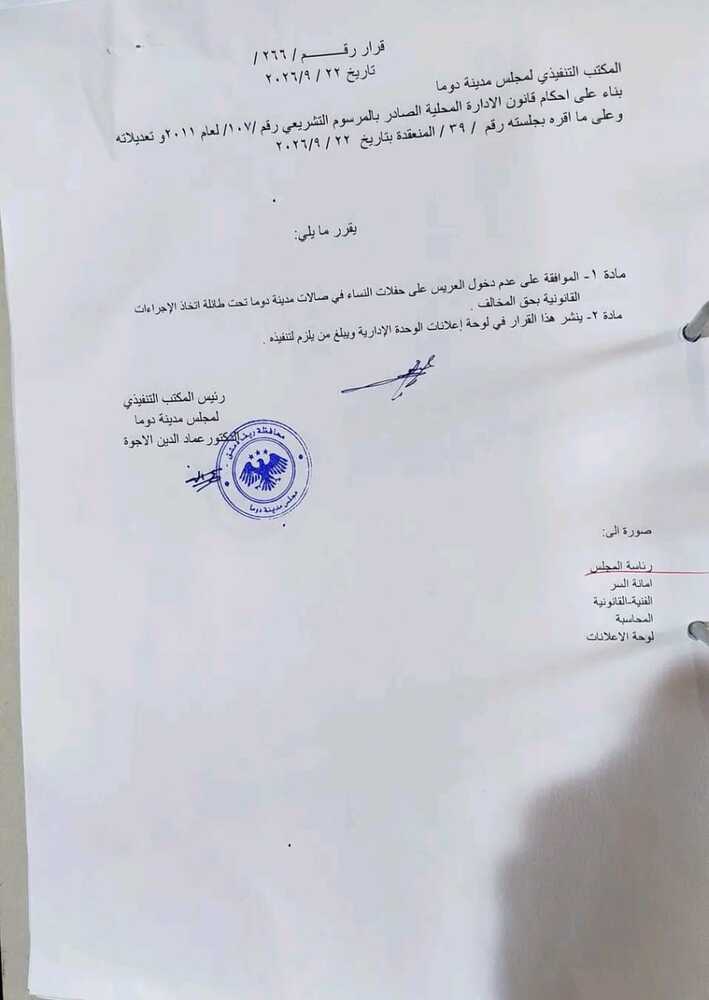
The most prominent questions concern the legal basis allowing the issuing authority to take action against violators, as well as the clarity of those measures and the nature of the penalties involved. Critics argue that the phrase “taking measures” does not specify the nature of the actions intended or which authority is empowered to enforce them.
The decision also raises a legal issue related to the principle of the rule of law, particularly regarding the imposition of penalties for violating an administrative decision without a clear legal provision defining the violation and the applicable punishment. This is in line with the principle that penalties may only be imposed on the basis of an explicit legal text.
Supporters of the decision, meanwhile, argue that it aims to organize wedding celebrations and protect the privacy of women’s parties. Opponents contend that regulating issues affecting social life and local customs requires a clear legal basis, a precise definition of the issuing authority’s powers, and clarification of the measures that may be taken against violators.
Ultimately, the decision has revived a broader debate over the limits of local administrations’ intervention in social life, and the distinction between regulating public affairs and interfering in personal customs and choices, within the framework of a state based on citizenship, the rule of law, and clearly defined powers and responsibilities.