-
Friday Sermons Spark Widespread Debate over Asala’s Concert: From Criticism of Singing to Calls to Prioritise the Poor and Displaced

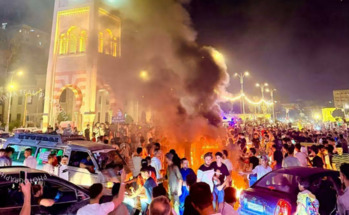
Dozens of video clips featuring mosque preachers in several Syrian provinces circulated after they addressed, during Friday sermons, the concert held by Syrian singer Asala Nasri on Thursday evening at Damascus’s Al-Fayhaa Sports Hall. The event drew criticism of varying intensity and substance, targeting the decision to hold the concert, ticket prices, the culture minister’s position on Asala’s return to Syria, and the public celebration of her return.
The clips published by the Observatory represent only a limited sample of dozens of sermons and recordings that were monitored. The Observatory is not seeking to transcribe all of them. The most prominent positions focused on opposition to holding musical concerts, criticism of spending on such events amid difficult living conditions, and calls to direct resources towards the poor, camp residents, displaced people, the wounded, and the families of those killed. Some speakers also raised issues related to rights and transitional justice.
In one sermon, Sheikh Mohammad Naim al-Hariri criticised the concert and claims that its proceeds would be allocated to charitable organisations. He asked: “Are we supposed to raise money through her singing… for charitable organisations?” He said that the priority should have been to “remind and advise her.” He also criticised singing, gender mixing, and the organisation of such events, which he viewed, according to his stated position, as manifestations of progress and civilisation.
In another sermon, a preacher criticised the culture minister’s position on Asala Nasri’s return, rejecting the portrayal of her return as a form of “the victory of the oppressed over the oppressor.” Addressing the minister, he said: “Shame on you, Minister of Culture, for saying this,” adding that, in his view, victory is represented by the return of displaced people, the restoration of rights, honouring those who were killed, implementing transitional justice, and returning homes to their owners.
Sheikh Abu Ahmad al-Jazairi, meanwhile, focused on the concert’s ticket prices, which he said ranged from $50 to $800. He asked: “Are the people in the camps not more deserving of this money? Are Syria’s poor not more deserving of this money?”
At the same time, al-Jazairi clarified that he did not object to honouring Asala because of her position in support of the Syrian revolution, saying: “Honour her—there is no problem.” However, he objected to linking the honour to the organisation of a musical concert, while also criticising singing and gender mixing from a religious perspective.
In another sermon, criticism centred on describing artists as an “icon of the revolution.” The preacher said: “The martyrs are the icon of the revolution,” adding that those who served the revolution, in his words, were “the people who gave their blood, whose homes were destroyed, and who lost their children.” He called for the wounded, the families of those killed, and those affected by the conflict to be placed at the forefront of public attention.
The Observatory also monitored a sermon containing sharp comparisons between concerts and festivals on the one hand, and the years of war and fighting on the other, as part of the preacher’s rejection of the current artistic scene. The Observatory refrained from republishing some offensive descriptions and statements that included glorification of violence and hatred, limiting its coverage to conveying the substance of the position expressed by the preacher.
In another example, a preacher responded indirectly to the culture minister’s remarks about Damascus remaining “until Judgment Day,” saying: “If we want Damascus to remain with us until Judgment Day, let us fear the Lord of Damascus.” He added: “Let us obey the Lord of Damascus and stay away from wrongdoing,” before quoting the Quranic verse: “If you are grateful, I will surely increase you.”
The clips monitored by the Observatory indicate that the controversy surrounding Asala Nasri’s concert has reached a number of Friday pulpits in different Syrian provinces. The debate also went beyond the concert itself to address the priorities of the current period, living conditions, displaced people, camps, victims, and transitional justice, as well as a broader discussion about public concerts and the role of the Ministry of Culture.
The Syrian Observatory for Human Rights stresses that freedom of expression and criticism—including religious, political, and cultural criticism—is a right that must be protected. At the same time, it rejects rhetoric based on insult, incitement, hatred, or the glorification of violence, and emphasises the need to preserve human dignity and Syrians’ right to disagree and express their views peacefully.