-
Lebanese Druze Sheikh of Reason: The People of Suwayda Must Decide Their Own Future
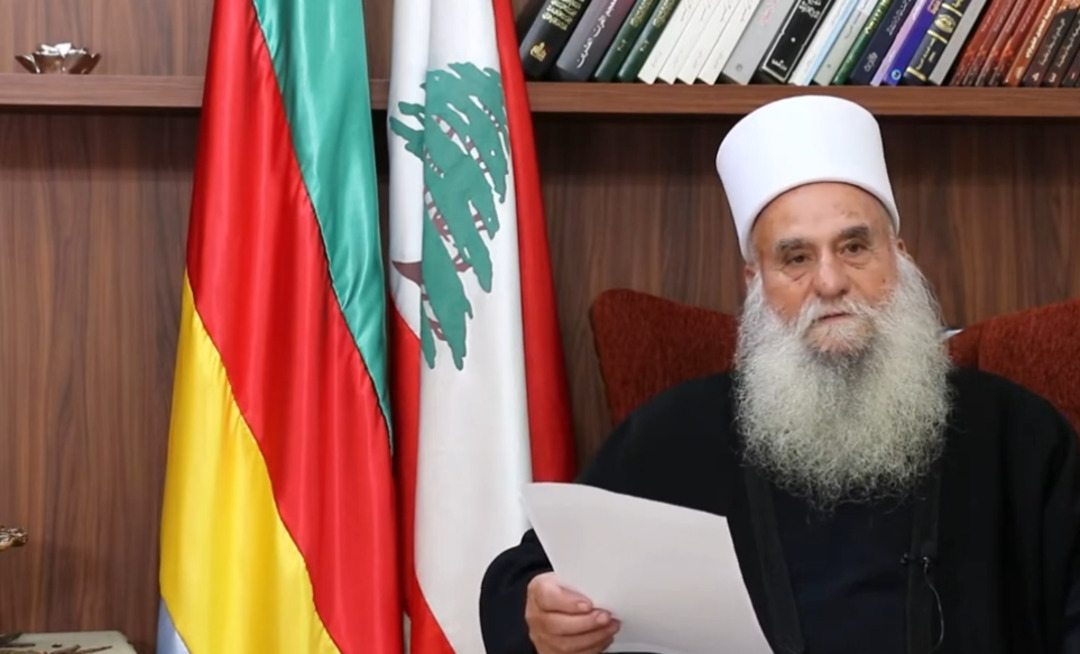
On 19 October 2026, the Suwayda Documentation and Media Center conducted an interview with Sheikh Nasr al-Din al-Gharib, the Sheikh of Reason of Lebanon’s Unitarian Druze community. The discussion addressed the fallout from the events in Suwayda in July 2025, his position on Syria’s current authorities, the governorate’s future, and its residents’ right to determine their own destiny.
The interview also touched on the continued presence of government forces in parts of Suwayda’s countryside, al-Gharib’s views on Walid Jumblatt’s moves, and the role Lebanon’s Druze religious leadership could play in supporting Druze in Syria.
**Following the massacres in Suwayda in July 2025, and the earlier massacres on the Syrian coast, do you believe what happened amounted to individual abuses by government forces, or does it reflect a structural flaw in the current authorities and their treatment of minorities?**
The massacres in Syria’s coastal region and in Suwayda cannot be dismissed as individual abuses, whether carried out by individuals or groups. What happened cannot be reduced to isolated acts or practices disconnected from the nature of the force deployed on the ground.
The forces that moved in with heavy vehicles and artillery used equipment available only to states. The scale of the mobilization and the military capabilities deployed cannot be separated from the parties able to provide and assemble them. According to the information we received, the number of those forces exceeded 50,000. Given the size of the mobilization and the means used, it is difficult to explain what happened as merely a series of individual abuses.
**After the massacres in Suwayda, do you consider Syria’s current authorities a partner that can be trusted, or do the people of Suwayda need international guarantees outside Damascus?**
We had hoped the current authorities would act in a spirit of national unity and citizenship, and that the state would serve as a framework for all Syrians, regardless of their religious or sectarian affiliations. Relations between citizens and the state should be based on equality and a shared sense of belonging to one country.
The former regime, which is described as dictatorial, was a secular, non-sectarian regime. Army personnel did not ask one another about their sects; they served under the banner of the nation, defending Syria and its borders. We had hoped that national identity would continue to take precedence, and that no Syrian community would feel threatened because of its identity.
As for guarantees, they should come from the state itself, whose institutions must be capable of protecting citizens and safeguarding their rights. The state should be a source of security—not a system whose citizens are forced to seek protection elsewhere because they have lost confidence in its ability to fulfill its responsibilities.
When a state is unable to respect and protect its citizens’ rights, the people of Suwayda have the strongest claim to determine their own future. They are best placed to understand their circumstances and decide what they believe is right for their future and for the protection of themselves and their land.
**How do you view the continued control of villages in Suwayda’s western and northern countryside by Syrian government forces?**
There is no doubt that the Syrian government’s control of areas in Suwayda’s northern and western countryside carries political significance. Its continuation cannot be viewed in isolation from developments in the governorate, the parties that intervened in the fighting, and those now playing a role in shaping the region’s future.
The party that helped and protected the Druze during that battle will have a role in determining what happens next. This raises questions about the future of these areas, the decisions concerning them, and the role of the parties involved in shaping the future of Syria’s three southern governorates.
The future of Suwayda and the south, therefore, involves more than military control of territory; it is tied to broader arrangements and understandings concerning the region. If the Syrian army considers itself the army of a state, it should allow residents to return to their homes.
**In light of the massacres committed by the Syrian authorities against the Druze in Syria, do you support the people of Suwayda’s calls to determine their political future and choose the arrangement they believe will best protect them?**
We do not interfere in the affairs of the people of Suwayda. They have a long history of defending Syria, not only the Mountain. Among them have been religious leaders, wise figures, thinkers, and politicians who have played a well-known role in the country’s history and its defense.
When catastrophe befell them, we expressed our position on what had happened and our hope that they would find security and well-being. But we received no call or request for advice from them, so we did not intervene in the choices they consider appropriate for their future.
The people of Suwayda are the first to be concerned with their affairs and the challenges they face. They are best placed to assess their circumstances and identify their needs. We do not wish to impose an opinion or interfere in their decisions. We simply hope they can reach the choices they believe will protect themselves, their land, and their future.
**Do you agree with Walid Jumblatt’s position on the Suwayda massacres and his relationship with the authorities in Damascus? Why?**
Leader Walid Jumblatt has his own views. He is a seasoned politician with regional and international relationships, and he has his own calculations and assessments that guide his approach to various issues.
In principle, however, we had expected at least one Arab condemnation of the crimes committed against innocent people in Suwayda. We expected a clear Arab position rejecting what civilians had endured and standing with the victims.
In our view, Walid Jumblatt would have been better advised to wait for an Arab condemnation before taking the two initiatives he later pursued. It was important for any political move to be preceded by a public Arab position condemning the crimes and expressing solidarity with the victims.
**What role can Lebanon’s Druze religious leadership play in protecting the Druze in Syria? Have you taken any political, legal, or humanitarian initiatives to help them?**
We do not currently have the influence needed to protect them. Other parties are better placed to take on that role, given their resources and ability to influence events and decisions concerning the region’s future.
That does not mean we failed to do what we could in the past. When others listened to our views and acted on them to protect members of the community, we did not hesitate to play our part. We sought to use our relationships and positions toward that end.
In the past, together with Prince Talal Arslan, we worked with the former regime to protect the Druze in Syria. We made considerable efforts, driven by our sense of responsibility and our concern for their safety and for shielding them from danger.
Today, we wish them success in their choices and decisions, and hope they can protect themselves and their land and overcome these difficult circumstances. We pray that God will protect and help them.
**Source:** Suwayda Documentation and Media Center